
Water-lubricated oil-free compressors – advantages over dry-running oil-free compressors
In many sectors, including chemicals, pharmaceuticals, food processing and electronics, compressed air must be completely clean and free of contaminants. Oil-free compressors are therefore essential where oil contamination must be eliminated.
In many sectors, including chemicals, pharmaceuticals, food processing and electronics, compressed air must be completely clean and free of contaminants. Oil-free compressors are therefore essential where oil contamination must be eliminated.
There are several types of oil-free compressors. Dry-running compressors use two rotating screw or tooth elements. Water-lubricated compressors use water for sealing and cooling. Scroll compressors provide quiet, efficient operation at lower capacities. Turbo compressors suit large air volumes. Each technology has specific advantages for different industrial applications.
This article focuses on the advantages of water-lubricated oil-free compressors compared with dry-running oil-free compressors.
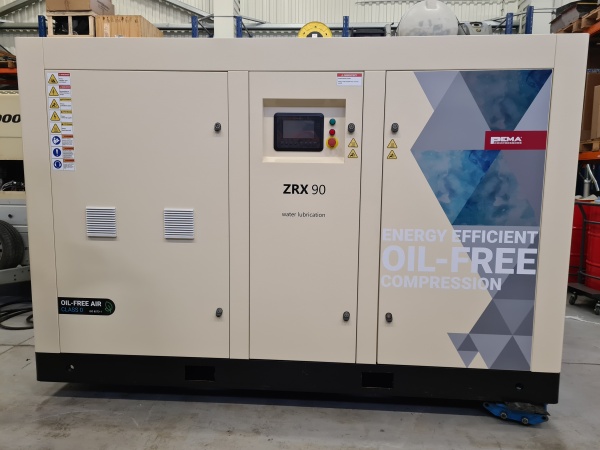
High efficiency and low specific energy consumption
Efficiency is a key factor when choosing a compressor. Water-injected compressors offer several important advantages over dry-running oil-free designs:
Lower operating temperature:
Lower speeds and less noise:
Direct drive and minimal mechanical losses:
Eliminating internal leakage:
High reliability, long service life, low servicing costs and environmentally responsible operation.
Reliability and low maintenance costs are key investment factors. Water-injected compressors have several design advantages that support long life and low servicing costs:
Simpler design
Fewer bearings and only one rotor:
Direct drive without a gearbox:
Lower speeds and temperatures:
Completely OIL-FREE:
Specific requirements of water-lubricated compressors
Despite their many benefits, water-lubricated compressors require osmosis-treated water to top up the internal circulation system. Some factories already have suitable water treatment equipment; otherwise, it is installed in the compressor station. This is not complex in terms of investment or operation, but must be included in the design.
Article photos
Show photosCollapse gallery