
How to control the costs of adsorption drying
How can you control adsorption drying costs? The purchase price is not the key factor: the adsorbent, regeneration method and pressure drops matter most.
How to control adsorption drying costs
The adsorbent is key, not just the regeneration method.
Adsorption drying removes moisture from compressed air using a solid filling material — an adsorbent. Typically, two pressure vessels, or towers, alternate between drying (adsorption) and regeneration (desorption). Refrigerant dryers, which use a refrigeration circuit, reduce the pressure dew point to around +3 °Ctd. Adsorption dryers can achieve much lower pressure dew points (PDP), down to −70 °Ctd or below depending on type. They are therefore suitable wherever freezing is a risk, such as outdoor pipework in winter, where condensation threatens distribution systems, or where processes require very dry air, such as pharmaceuticals, surface treatment and food production.
For compressed air generation costs, the rule is simple: the drier the air required, the more important the adsorbent's quality and type, the regeneration method and the dryer's pressure losses become. Refrigerant drying usually has stable, relatively low energy demand, whereas adsorption dryer operating costs can vary by tens or even hundreds of percent between models. This is where significant money is saved or lost.
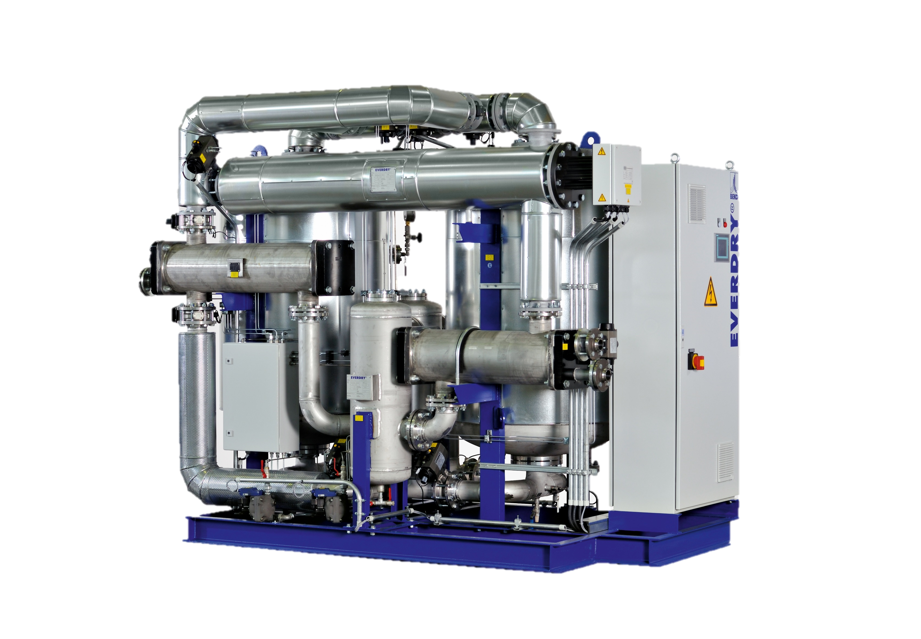
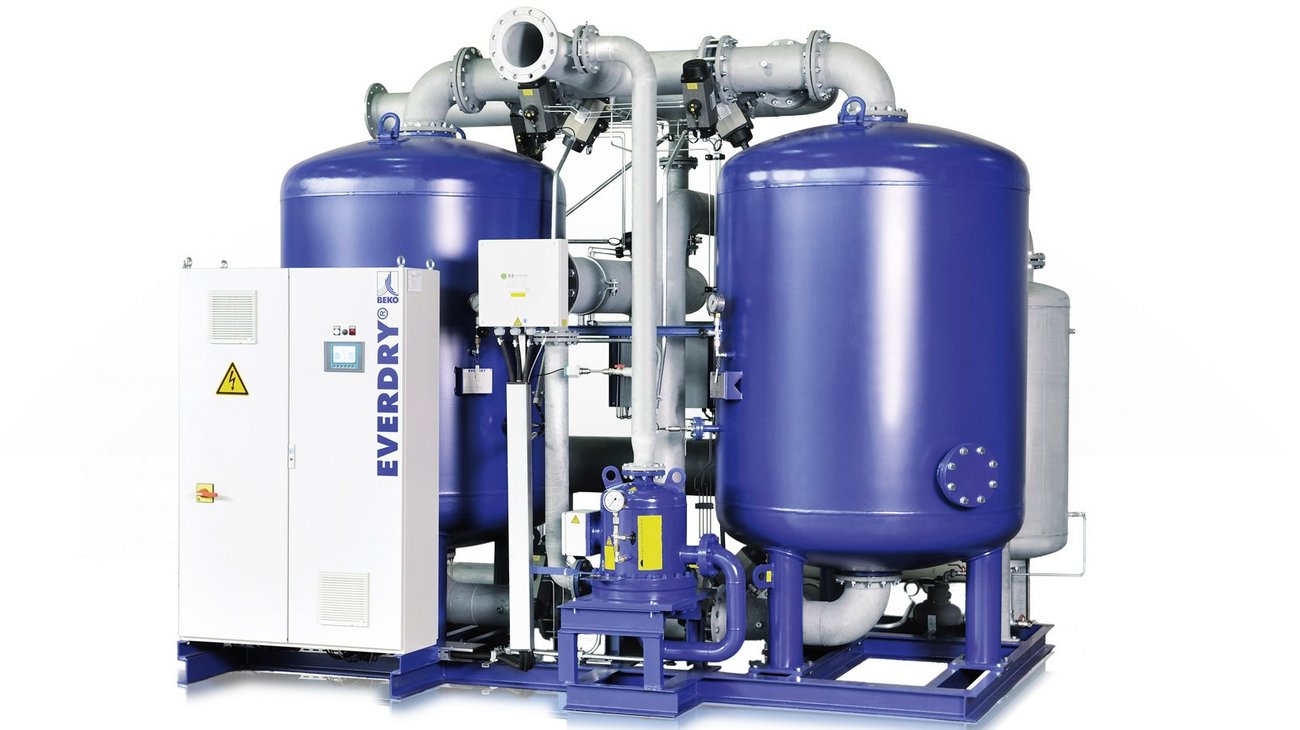
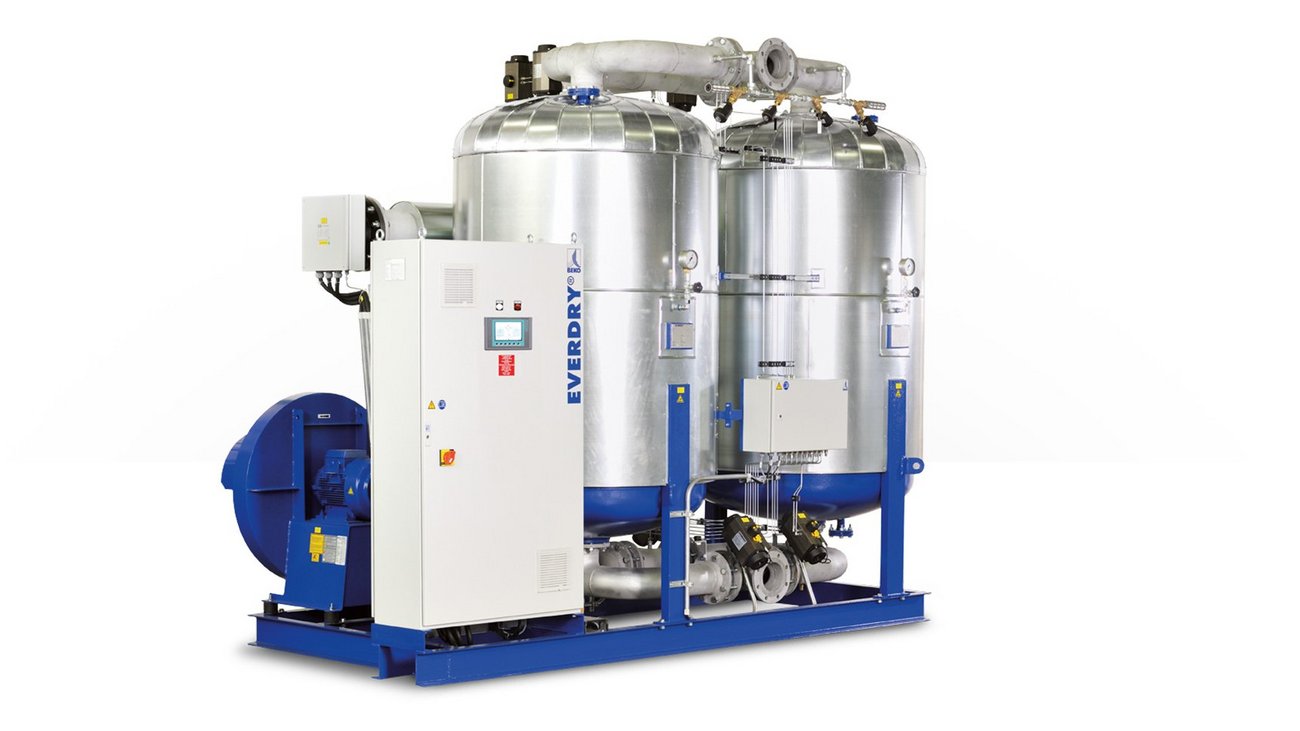
In energy simulations and our compressed air audits, BEKO Technologies' EVERDRY dryers increasingly stand out, mainly because of their high-quality Sorbead® adsorbent, smart regeneration, low Δp and very good total cost of ownership (TCO). This article highlights the key differences that have a major impact on operating costs.
Adsorbent: the heart of an adsorption dryer
The adsorbent is the heart of the dryer. Standard activated alumina (AA) or a silica gel blend becomes brittle and crumbles over time, producing dust, increasing pressure drop (Δp) and worsening the dew point. The result is more frequent servicing, higher compressor power input and earlier replacement of the filling.
BEKO EVERDRY uses the effective Sorbead® adsorbent (aluminosilicate gel) with high
mechanical and thermal resistance. In practice, this means:
• A stable dew point over the long term, without deterioration
after just a few years of operation.
• Low abrasion → minimal dust in the bed, valves
and pipework.
• Low, stable Δp, so the compressor does not work
against a clogged bed.
The result: longer bed life and lower energy consumption in everyday operation.
Regeneration energy: purge air (heatless) versus heated regeneration
The largest operating cost is undoubtedly the energy required for regeneration.
• Heatless-regenerated dryers use compressed air for regeneration (PURGE). Typically, this consumes 12–25% of the dryer's rated capacity. In simple terms, expensively produced compressed air is immediately used to regenerate one desiccant tower. For example, a dryer rated at 1,000 m3/h consumes 120–250 m3/h of compressed air just for regeneration.
• Heated-regeneration dryers with an external blower reduce compressed air consumption to a minimum or even zero — ZERO PURGE. They regenerate independently of the compressor using heated ambient air supplied by a blower, rather than valuable compressed air. On average, their regeneration energy requirement is roughly half that of heatless dryers. Heating can also use alternative energy sources available on site, such as hot flue gases, steam and steam condensate, or waste heat from the compressor itself, providing further substantial operating savings.
• Dew-point control is a basic control feature of modern adsorption dryers, regardless of regeneration method. The integrated pressure dew point (PDP) sensor and controller limit regeneration to actual demand, significantly reducing operating costs for both heatless and heated-regeneration dryers. PDP control further widens the efficiency gap because heated-regeneration dryers can use the desiccant's full capacity, which heatless dryers cannot.
EVERDRY combines high-quality Sorbead® adsorbent, which requires lower desorption temperatures, with heating and smart control. In practice, this means lower heating power and less compressed air loss than conventional HEATLESS dryers.
Pressure drop (Δp): a small number, a large cost
Each additional 0.1 bar of pressure drop typically increases compressor power input by approximately 0.7–1.0%.
Example: a 100 kW compressor runs 8,000 hours per year. If ageing of the dryer bed adds 0.3 bar of pressure drop, compressor energy use rises by approximately 2–3%, or 16,000–24,000 kWh/year depending on actual efficiency. That is the cost of Δp alone, excluding regeneration. EVERDRY's stable Sorbead® bed keeps Δp low and stable as the years pass.
Maintenance and adsorbent replacement
Dust from degraded adsorbent clogs filters, valves and heat exchangers, shortens maintenance intervals and increases the risk of downstream equipment failures. “Fines” are the fine dust particles produced as the adsorbent crumbles. Sorbead® in EVERDRY produces significantly fewer, so it:
• Extends maintenance intervals and shortens downtime,
• Makes bed replacement easier and cleaner,
• Reduces the risk of product rejects caused by secondary contamination.
Illustrative impact on total cost of ownership (TCO)
TCO is more than the purchase price. For adsorption drying, it includes:
• Compressor energy lost to dryer pressure drop (Δp),
• Regeneration energy (heating and any purge air),
• Adsorbent life and stability (impact on dew point, Δp and maintenance),
• Planned and unplanned downtime (filters, valves and bed replacement).
EVERDRY with Sorbead® performs well in all four areas:
• Lower, stable Δp = less hidden compressor energy use.
• Efficient regeneration (heating, blower and dew-point control) = less wasted compressed air.
• Stable dew point = no excessive heating or unnecessary regeneration caused by an ageing bed.
• Less dust and longer intervals = lower maintenance costs and higher availability.
We normally calculate TCO over 10 years using realistic inputs: annual use of approximately 6,000–8,400 hours, electricity price scenarios, changes in Δp over time, the chosen regeneration mode (heatless or heating with a blower and dew-point control), planned maintenance cycles for filters and bed replacement, and downtime risk. Each project also includes a sensitivity analysis varying key parameters by ±10–20%.
Our calculations consistently show the same long-term result: BEKO EVERDRY with Sorbead® achieves the best result over a 10-year period. The combination of low, stable Δp, efficient controlled regeneration and long bed life consistently reduces both energy and maintenance costs. Where a cheaper heatless alternative with higher purge air consumption and a standard adsorbent was considered, the initial purchase saving was often exhausted after just 18–36 months, depending on operating hours and electricity tariff. After 10 years, the final difference is substantially in EVERDRY's favour.
Adsorption drying is complex: the right design can save a great deal of money, while the wrong one can waste it. When choosing a dryer, always consider adsorbent quality and composition, regeneration method and control, guaranteed and stable long-term Δp, realistic maintenance intervals including spare-part availability and downtime, and above all TCO calculated for your actual conditions: flow, pressure, required PDP, electricity tariff and climate.
Article photos
Show photosCollapse gallery